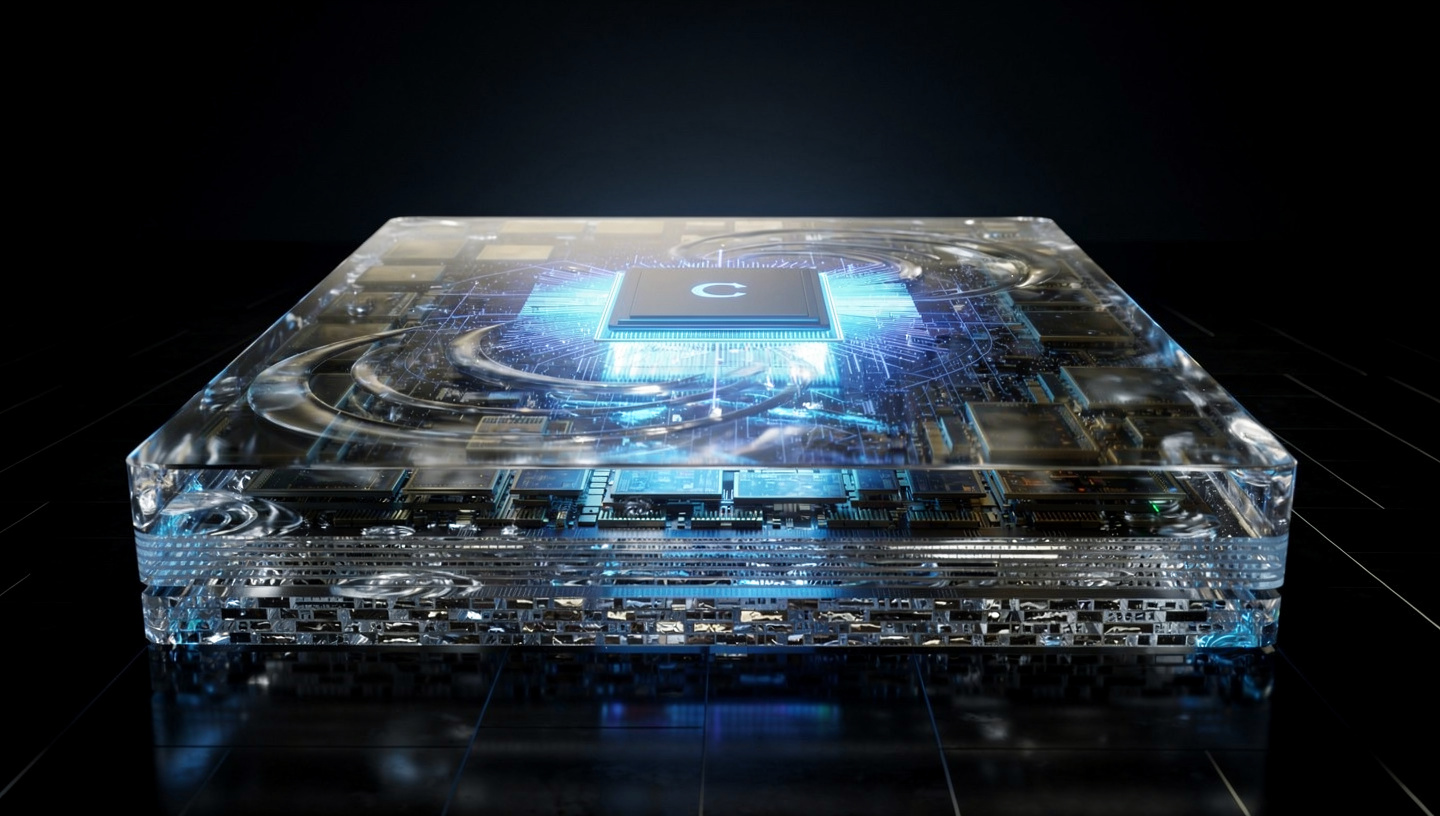
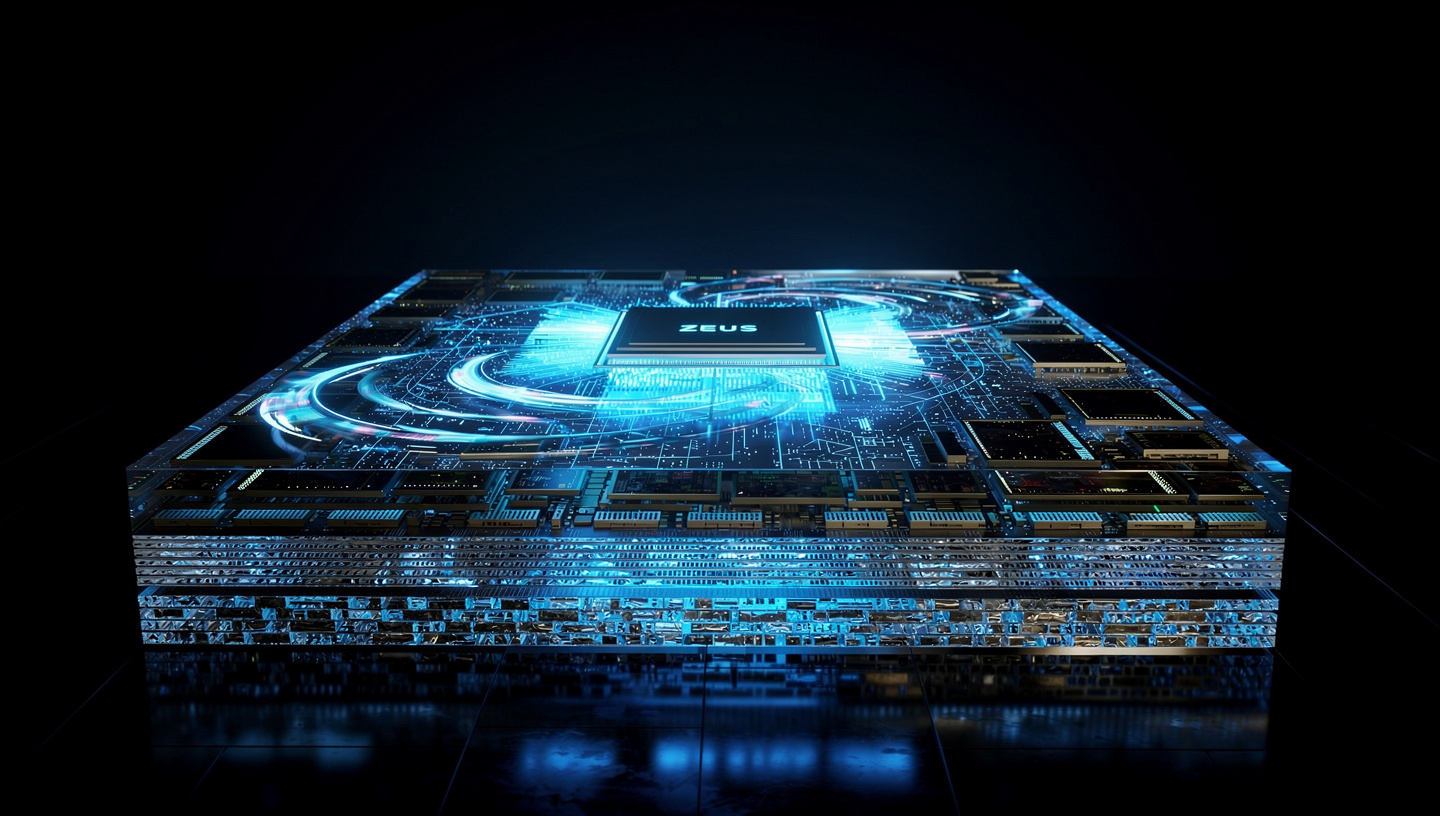
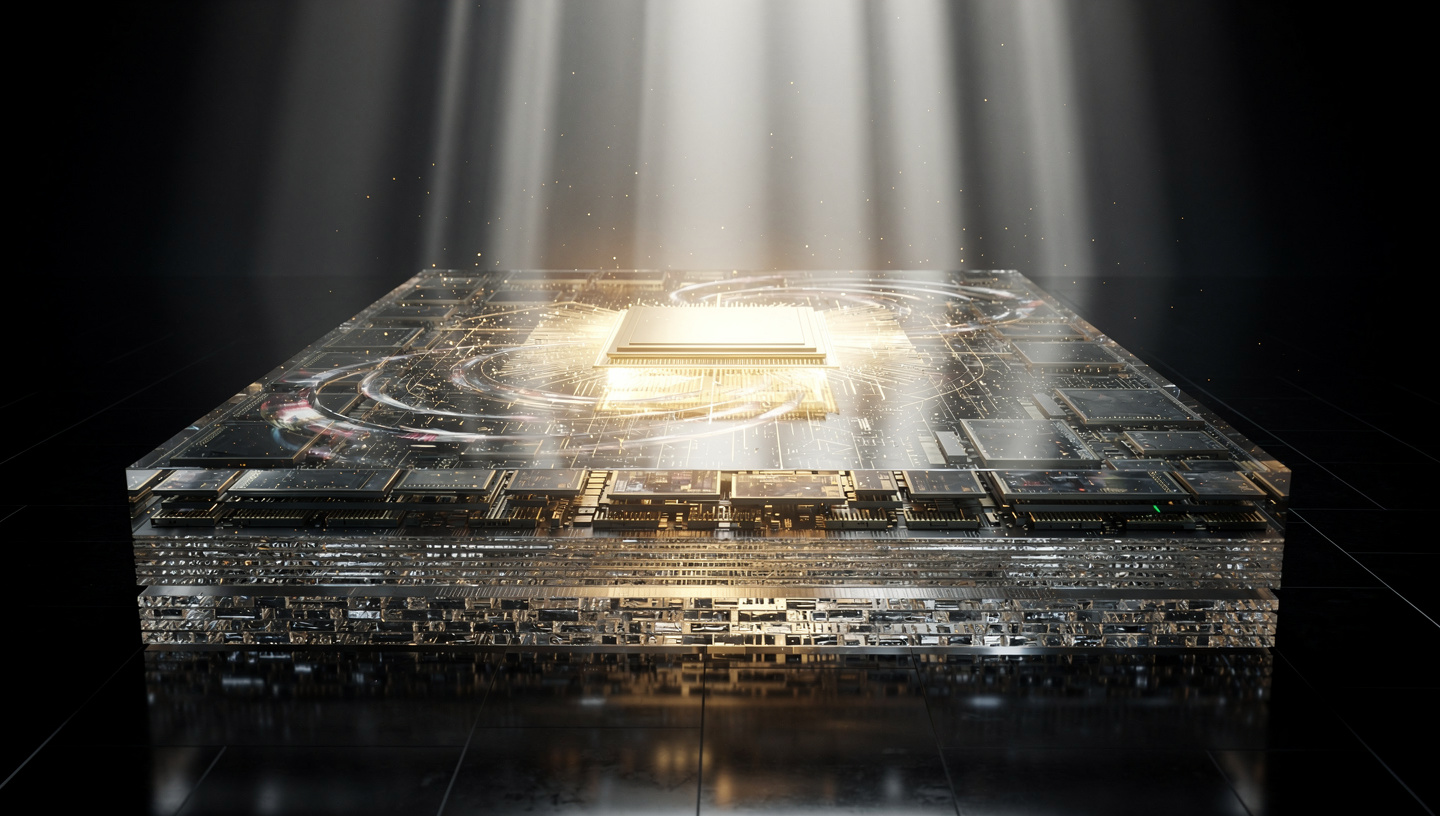
EdgeChip E1 vs Apple M4. EdgeChip Zeus vs every AI accelerator on Earth. EdgeChip Exodus — never licensed, never matched, never revealed except in private for a 10-figure conversation. MoS₂ replaces silicon. WATS replaces TSMC. No foreign foundry. No ARM license. No silicon. Ever.
EdgeChip E1 is a MoS₂-fabricated processor grown entirely by the WATS machine. No silicon. No TSMC. No foreign foundry of any kind. The chip architecture runs 11 layers of 2D semiconductor material — each layer grown photochemically at atomic precision, zero defects by design.
The 10 E1-S compute layers deliver ~250 million cores, 200 trillion TFLOPS, and a 25 THz clock across a 30mm × 30mm die containing 400 trillion transistors. On-die memory: 2–20 petabytes. No separate GPU. No separate RAM. No separate storage. One EdgeChip E1. One firmware. ~250 million cores. On-die memory scales with the 400 trillion transistor die — measured in petabytes to exabytes. No separate RAM. No separate GPU. No separate storage. Everything is the chip.
E1-C is not a firmware variant and not a separate chip — it is the bottom grown layer of every EdgeChip E1, the root of trust, unreachable from the E1-S compute layers above it except through a single one-way hardware channel grown into the chip structure. E1-C runs eight post-quantum cryptographic algorithms in hardware — ML-KEM-1024, ML-DSA-87, SLH-DSA, AES-256-GCM, SHA-3-512, BLAKE3, plus two additional. Keys generated in E1-C never leave the E1-C layer. The E1-S layers above are treated as potentially compromised by default. The security is grown in, not configured in.
Sub-1V operation across the full chip means power consumption at a fraction of silicon equivalents. MoS₂ enables transistor operation below the voltage floor that silicon requires — an inherent material advantage that no silicon fab process can engineer around.
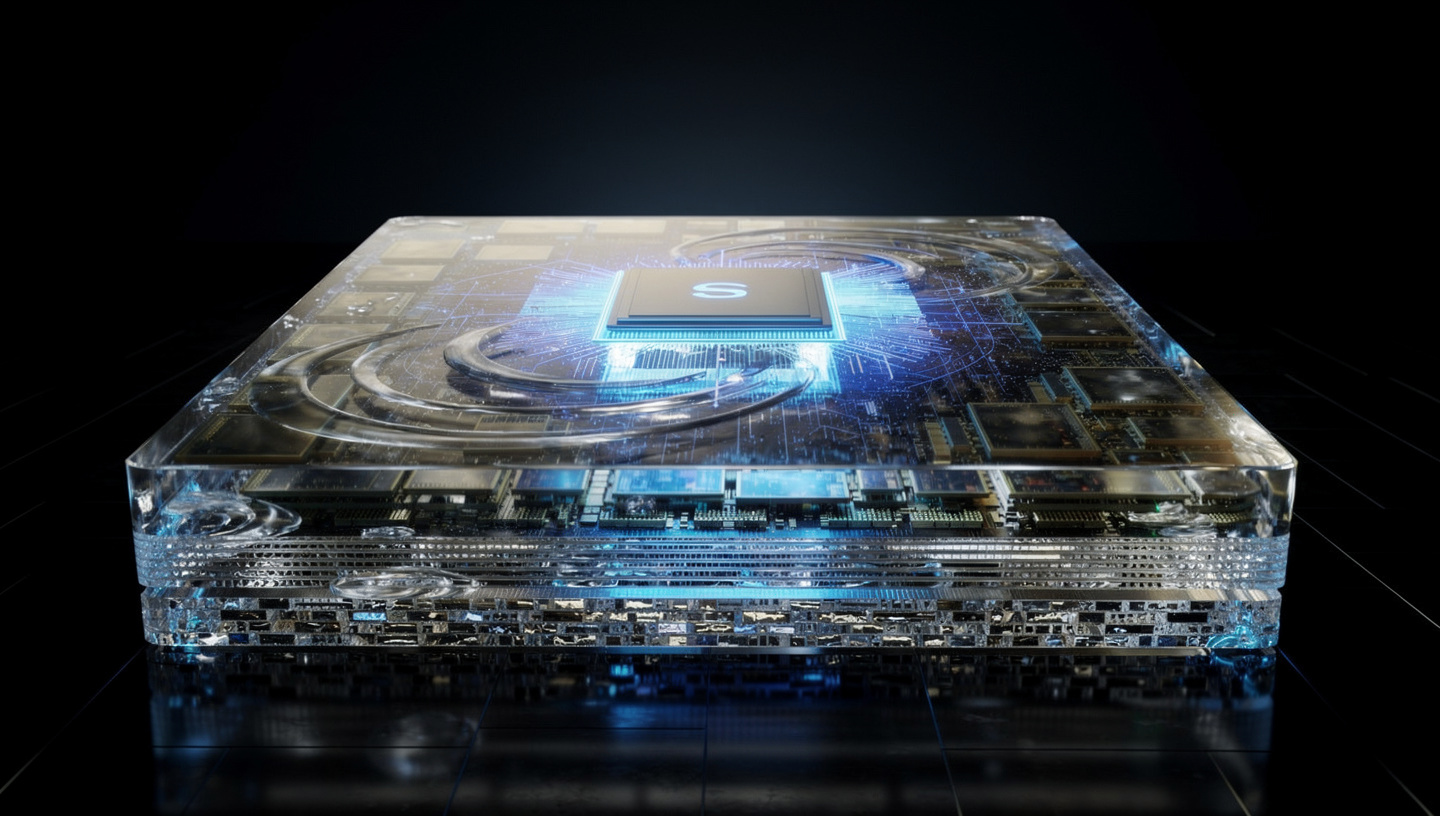
Every processor Apple, AMD, Intel, and Qualcomm makes runs on silicon fabricated at TSMC in Taiwan. A single geopolitical event ends that supply chain. EdgeChip E1 has no silicon, no TSMC, and no Taiwan dependency — and it ships with post-quantum cryptography that none of those chips have at all.
| Metric | EdgeChip E1 | Apple M4 Pro | AMD EPYC 9654 | Qualcomm Snapdragon X Elite |
|---|---|---|---|---|
| Substrate | MoS₂ — no silicon, no foreign foundry | Silicon — TSMC N3B, Taiwan | Silicon — TSMC N5, Taiwan | Silicon — TSMC N4P, Taiwan |
| Layers | 11 grown MoS₂ layers — atomic precision | Single-layer — planar silicon process | Single-layer — planar silicon process | Single-layer — planar silicon process |
| CPU Cores | 48 per chip — 144 in EdgeConsole Titan (3 chips) | 12 performance + 4 efficiency | 96 cores per socket | 12 Oryon cores |
| Integrated RAM | 2–20 petabytes on-die — 30mm × 30mm — zero separate DRAM ever | On-package HBM — separate process | Requires DDR5 — fully separate modules | Requires LPDDR5 — separate modules |
| Post-Quantum | E1-C hardware enclave — 8 algorithms, unbypassable | None | None | None |
| Operating Voltage | Sub-1V — MoS₂ material advantage | ~1.0–1.2V — silicon floor | ~1.8V — high-core-count silicon | ~0.9–1.1V — silicon floor |
| Supply Chain | Fully sovereign — WATS-grown, US only | TSMC Taiwan — geopolitical risk | TSMC Taiwan — geopolitical risk | TSMC Taiwan — geopolitical risk |
| License Required | None — sovereign architecture | ARM license + TSMC process license | x86 architecture license | ARM license + Qualcomm IP |
EdgeCipher is the cryptographic architecture that runs inside the E1-C chip variant. Eight hardware-implemented algorithms form an unbypassable post-quantum security suite: ML-KEM-1024 (key encapsulation), ML-DSA-87 (digital signature), SLH-DSA (stateless hash-based signature), AES-256-GCM (symmetric encryption), SHA-3-512 (hashing), BLAKE3 (fast hashing), and two additional algorithms. All three NIST post-quantum standards are covered simultaneously in hardware.
The architecture is physically unique: E1-C never connects to E1-S through any software-accessible interface. There is a single one-way hardware channel between them — data flows in one direction only, and only for specifically authorized cryptographic operations. A compromised E1-S operating system cannot access E1-C. A software exploit cannot reach it. A side-channel attack cannot extract keys because the keys never exist outside the E1-C silicon boundary.
Every key generated in E1-C stays in E1-C. Signing happens in hardware. Verification happens in hardware. ML-DSA-87 produces 124-byte signature packets in hardware at line speed. The attack surface is physical only — the chip must be in your hand to be attacked.
NIST FIPS compliant. Ready for deployment in classified environments, financial infrastructure, defense systems, and any application where "post-quantum" cannot mean a software layer that an OS exploit can bypass.
Software encryption runs on the same processor that runs your operating system. If the OS is compromised, the encryption is compromised. Hardware security modules exist but add cost, complexity, and still share attack surface with the host system. EdgeCipher eliminates shared attack surface entirely — E1-C is physically isolated at the silicon level.
| Metric | EdgeCipher / E1-C | AES-256 Software | HSM Module (Thales, Entrust) | Apple Secure Enclave |
|---|---|---|---|---|
| Attack Surface | Physical only — hardware isolated, no software path | Full software attack surface — OS exploitable | Physical + software — network interface exposed | Physical + software side-channel risk |
| Post-Quantum | All 3 NIST standards — ML-KEM-1024, ML-DSA-87, SLH-DSA | None — classical only, quantum-vulnerable | Partial — add-on modules, not native | None — classical ECC only |
| Key Storage | E1-C enclave — keys physically never leave chip | RAM / disk — software accessible | HSM secure element — but network connected | Secure element — but same SoC as main CPU |
| Architecture | One-way hardware channel — E1-C never connects to E1-S | Shared processor with OS — fully exploitable | Separate hardware but software interface required | Separate core but shared SoC — side-channel risk |
| Signing Speed | ML-DSA-87 hardware — 124-byte packets at line speed | Software RSA/ECC — CPU cycles, slow | Hardware but proprietary — vendor-locked | ECC hardware — fast but not post-quantum |
| NIST Compliance | FIPS compliant — all 3 PQC standards | FIPS for classical — no PQC | FIPS compliant — classical + partial PQC | Not FIPS compliant |
| Integration | Same chip as compute — zero additional hardware | Software — no hardware needed | Separate dedicated hardware module — added cost | Integrated into Apple SoC only |
EdgeMemory is a MoS₂/HZO ferroelectric FET non-volatile memory cell grown in the same WATS run as the EdgeChip. 2 nanosecond switching speed — 100,000 times faster than the best NAND flash. 10¹⁰ endurance cycles. Sub-1V operation. Data survives power-off without the volatility of DRAM or the slowness of NAND. It is simultaneously faster than DRAM and non-volatile like storage — a category that does not exist in silicon.
EdgeModem EM-1 integrates 5G NR, WiFi 7, Bluetooth 5.4, and GPS simultaneously on a single MoS₂ die — grown in the same WATS run as EdgeChip. No Qualcomm license. No ARM license. Post-quantum encryption applied at baseband before the RF signal ever leaves the chip. Every bit transmitted by EdgeModem is encrypted in hardware before transmission. No cleartext exists in the signal chain at any point.
NAND flash is slow. DRAM is fast but volatile. No existing memory technology is simultaneously fast, non-volatile, high-endurance, and grown on the same substrate as the processor. EdgeMemory is all four simultaneously.
| Metric | EdgeMemory (FeFET) | Best NAND Flash (3D TLC) | DRAM (DDR5) | Intel Optane (3D XPoint) |
|---|---|---|---|---|
| Switching Speed | 2 nanoseconds | ~100–200 microseconds — 100,000x slower | ~10–20 nanoseconds — 5–10x slower | ~10 microseconds — 5,000x slower |
| Endurance Cycles | 10¹⁰ cycles | ~3,000–10,000 cycles — 1,000,000x fewer | ~10¹⁵ cycles — volatile | ~10⁶ cycles — discontinued |
| Non-Volatile | Yes — data survives power-off | Yes | No — data lost at power-off | Yes — but discontinued |
| Operating Voltage | Sub-1V | 3.3V program voltage | 1.1V — high leakage | ~1.8V |
| Substrate | MoS₂ — same WATS run as EdgeChip | Silicon — separate NAND fab required | Silicon — separate DRAM fab required | Silicon — discontinued (Intel exited) |
| Integration | Grown into EdgeChip — zero separate module | Separate die, separate package, separate board | Separate DIMM or package — always external | Separate module — required special mobo |
Every chip Apple, AMD, Intel, NVIDIA, and Qualcomm makes depends on TSMC in Taiwan, ARM IP licenses, and silicon wafers. Edge SMT depends on none of those things. WATS grows the chip. MoS₂ replaces silicon. EdgeCipher replaces every cryptographic module ever built. EdgeMemory replaces NAND and DRAM simultaneously. EdgeModem replaces Qualcomm. The entire semiconductor stack — grown from recipe files, domestically, in a machine that fits in a room. The supply chain problem is solved at the materials level.